Smart Home Hub Showdown 2025: Home Assistant Green vs Hubitat C8 Pro vs SmartThings
Which Hub Should You Build Around?
Every smart home starts with a hub. It’s the brain — the box that translates commands between Zigbee, Z-Wave, Thread, Wi-Fi, and Matter devices. Choose wrong and you waste months on a platform that doesn’t fit your tolerance for tinkering, your budget, or your device mix.
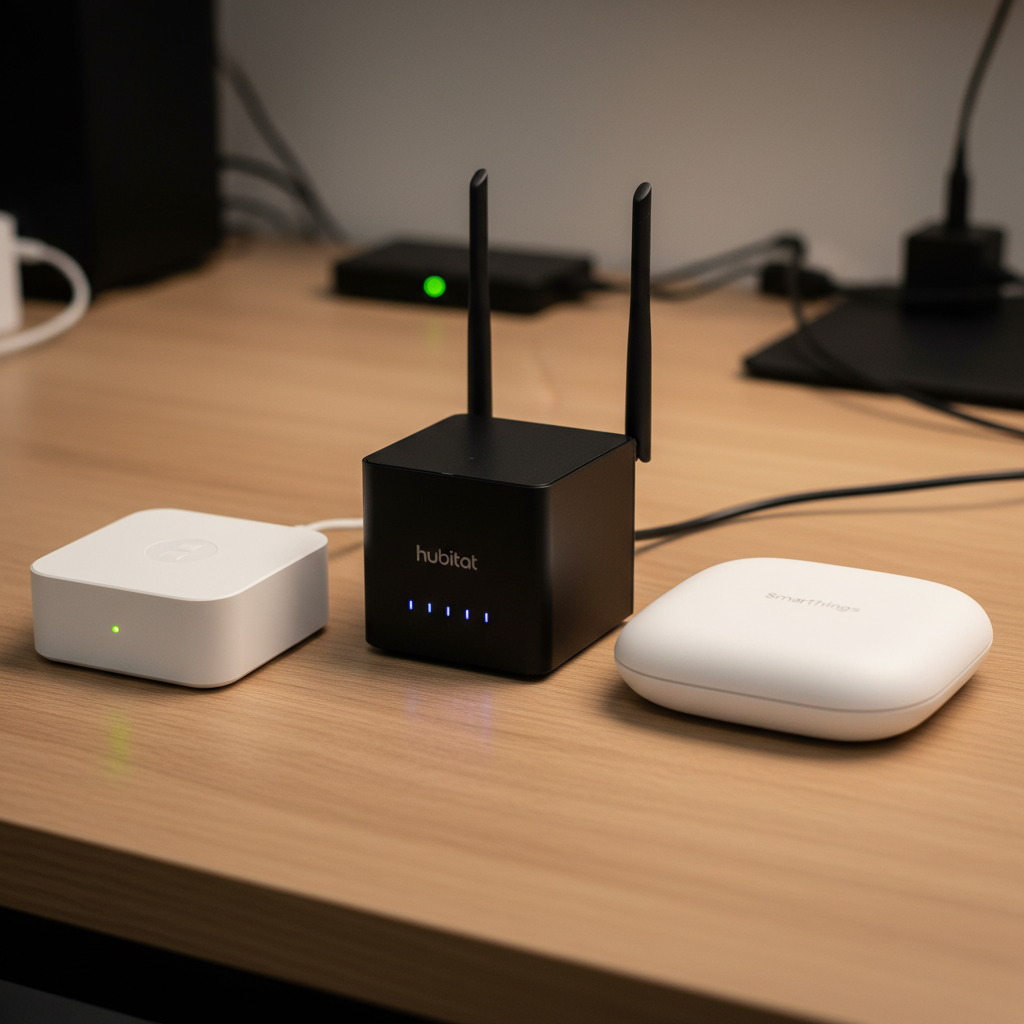
This comparison covers the three most popular DIY smart home hubs as of mid-2025: Home Assistant Green (official hardware from Nabu Casa), Hubitat Elevation C8 Pro, and the Aeotec SmartThings Hub (current hardware for Samsung’s SmartThings platform).
All prices are sourced from manufacturer pages, Amazon, or Samsung.com as of May 2026.
At a Glance: The Spec Sheet
| Spec | Home Assistant Green | Hubitat C8 Pro | SmartThings (Aeotec V3) |
|---|---|---|---|
| Price | $199 (home-assistant.io/green) | $169.95 (Amazon listing, was $199.95 MSRP) | $119.99 (Samsung.com) - $149.99 (Amazon) |
| CPU | Rockchip RK3566, quad-core Cortex-A55 @ 1.8 GHz | ARM Cortex-A55 @ 2.016 GHz | Not publicly specified |
| RAM | 4 GB LPDDR4X | 2 GB | Not publicly specified |
| Storage | 32 GB eMMC | Not publicly specified | Not publicly specified |
| Zigbee | ❌ (requires $35 ZBT-2 dongle) | ✅ Zigbee 3.0 | ✅ Zigbee |
| Z-Wave | ❌ (requires USB stick) | ✅ Z-Wave 800 Series (Long Range) | ✅ Z-Wave Plus |
| Matter | ✅ (via ZBT-2/Thread) | ✅ Matter 1.5 | ✅ Matter + Thread border router |
| Bluetooth | ✅ (via USB) | ✅ Built-in | ❌ |
| Ethernet | ✅ Gigabit | ✅ | ✅ |
| Wi-Fi | ❌ | ✅ Internal | ✅ |
| Local Control | ✅ Full | ✅ Full | ⚠ Hybrid (Edge drivers local, app cloud) |
| Voice Control | Requires $65/yr Cloud sub | Free (Alexa/Google) | Free (Alexa/Google) |
| Setup Time | ~15 min (pre-installed HA) | ~30-60 min | ~10 min (app-guided) |
| Device Support | 1,000+ integrations, 200K+ devices | 1,000+ devices, 100+ brands | Thousands via SmartThings ecosystem |
Home Assistant Green ($199) — Maximum Flexibility
Home Assistant Green is the official plug-and-play hardware for Home Assistant, the open-source smart home platform. It comes with Home Assistant OS pre-installed — plug in power and Ethernet, and it auto-discovers devices on your network.
Hardware details (home-assistant.io/green):
- Rockchip RK3566 SoC, quad-core Cortex-A55 @ 1.8 GHz
- 4 GB LPDDR4X RAM, 32 GB eMMC storage
- Gigabit Ethernet, 2× USB 2.0, HDMI (diagnostics only)
- Idle power: ~1.7 W, Load: ~3 W — fanless, silent
The catch: Green has zero built-in radios. To connect Zigbee or Thread devices, you need the Home Assistant Connect ZBT-2 ($34.95). For Z-Wave, you need a USB stick like the Zooz Z-Wave Plus 800 series ($39.99). These add $35-75 to the base price.
Cloud subscription: Nabu Casa subscription is $65/year (pricing page). Required for Alexa/Google voice control and cloud-based remote access. Not required for local operation.
Pros:
- Most extensive device/integration library of any platform — 1,000+ integrations
- Fully local operation; no cloud dependency for automations
- Monthly updates from the largest open-source smart home community
- Advanced automation engine + NodeRED + HACS ecosystem
- No per-device license fees
Cons:
- No built-in Zigbee/Z-Wave — additional hardware required
- Voice control needs $65/year cloud subscription
- Steeper learning curve than SmartThings or Hubitat
- Wi-Fi not included — Ethernet only (USB Wi-Fi dongles work)
Hubitat Elevation C8 Pro ($169.95) — Local-First Commercial Power
Hubitat was built by ex-SmartThings contributors who wanted fully local control without open-source complexity. The C8 Pro is their latest hardware, adding Z-Wave Long Range and Matter 1.5 support.
Hardware details (Amazon product page):
- ARM Cortex-A55 @ 2.016 GHz
- 2 GB RAM
- Z-Wave 800 Series (Long Range, up to 1.5 mile range claimed)
- Zigbee 3.0, Bluetooth, Matter 1.5
- External high-performance antennas
- Ethernet, Wi-Fi, USB-C power
- 2.95 × 3.23 × 0.67 inches, 2.56 oz
The advantage: Everything is in the box. Zigbee, Z-Wave, Bluetooth, and Matter are all built in. No dongles, no sticks, no additional purchases for radio support. The external antennas give noticeably better range than internal-antenna hubs.
Optional subscriptions (hubitat.com):
- Backup & Hub Protection: $29.95/year
- Remote Admin: $2.99/month
- Hub Protect + Remote Admin bundle: $54.99/year
Pros:
- All radios built-in (Zigbee 3.0, Z-Wave 800 LR, Bluetooth, Matter 1.5)
- Fully local — automations run without internet
- Voice control (Alexa, Google) included at no extra cost
- External antennas for superior wireless range
- Regular software updates with AI-assisted automations
- Strong community with Rule Machine for advanced automations
Cons:
- Smaller device ecosystem than Home Assistant (1,000+ vs 200K+)
- 2 GB RAM limits very large setups vs Green’s 4 GB
- Web-based admin interface is powerful but dated
- Some Z-Wave device compatibility issues reported (2,124 Amazon reviews avg 4.0 stars)
SmartThings (Aeotec Hub V3, $119.99-$149.99) — Beginner-Friendly Ecosystem
The Aeotec Smart Home Hub is the current hardware running Samsung’s SmartThings platform. It’s the most consumer-friendly option with the largest out-of-box device ecosystem.
Hardware details (Samsung.com, Amazon):
- Z-Wave Plus, Zigbee, Matter (Thread border router)
- Ethernet and Wi-Fi connectivity
- 4.2 out of 5 stars (2,124 Amazon ratings)
- Works with Alexa and Google Assistant
- Available in V3 (with Z-Wave, $149.99) and V4 (no Z-Wave, lower price)
The reality check: SmartThings started as a cloud-dependent platform. Since 2022, Samsung pushed Edge drivers to enable local automation execution — time-sensitive automations (lights, locks) now run on the hub. But the SmartThings app and many advanced features still require internet connectivity. If your internet goes down, your app stops working even if some automations continue locally.
Pros:
- Lowest entry price ($119.99-$149.99)
- Easiest setup — SmartThings app guides you through everything
- Largest consumer smart home ecosystem
- Matter + Thread border router built in
- Free voice control with Alexa and Google Assistant
- No subscription fees
Cons:
- App requires internet — no local app control during outages
- Advanced automations are limited compared to HA or Hubitat
- Hardware specs not publicly available (lower-end vs competitors)
- Z-Wave V3 version only; V4 drops Z-Wave entirely
- No device transfer utility — replacing an old hub requires factory resetting every device
- No Apple HomeKit support
The Cost Over Time: 3-Year TCO
Initial hardware cost is only part of the picture. Here’s what you actually spend over three years:
| Cost Component | Home Assistant Green | Hubitat C8 Pro | SmartThings Aeotec |
|---|---|---|---|
| Hub | $199 | $169.95 | $149.99 |
| Zigbee dongle | $34.95 (ZBT-2) | ✅ Built-in | ✅ Built-in |
| Z-Wave stick | $39.99 (Zooz 800) | ✅ Built-in | ✅ Built-in |
| Cloud/voice subscription | $195 (3 yrs × $65) | $0 | $0 |
| 3-Year Total | $468.94 | $169.95 | $149.99 |
Home Assistant Green costs nearly 3× more over three years when you factor in the dongles and cloud subscription. Hubitat C8 Pro comes out ahead on value if you want built-in Z-Wave + Zigbee without subscriptions. SmartThings is cheapest upfront and over time, but you trade local control and automation power.
Which One Should You Buy?
Choose Home Assistant Green ($199 + extras) if:
- You want the absolute widest device compatibility (200K+ devices)
- You enjoy tinkering and don’t mind YAML configuration
- You want to build complex automations with NodeRED or HACS
- You’re okay buying separate dongles for Zigbee and Z-Wave
Choose Hubitat C8 Pro ($169.95) if:
- You want fully local control without open-source maintenance
- You need both Zigbee and Z-Wave out of the box
- You want external antennas for large-home coverage
- You’re comfortable with web-based admin (not as polished as SmartThings app)
- You want zero ongoing subscription costs
Choose SmartThings Aeotec ($119.99-$149.99) if:
- You want the easiest setup with broad brand compatibility
- You’re already in the Samsung ecosystem
- You don’t mind cloud dependency for the mobile app
- You don’t need Z-Wave (or buy the V3 specifically)
- You want the lowest total cost of ownership
Bottom Line
There’s no single best hub — they serve different users. SmartThings is for people who want things to just work. Hubitat is for people who want local control without managing Linux. Home Assistant is for people who want maximum flexibility and are willing to work for it.
The difference between $150 and $470 over three years isn’t the hardware — it’s whether you need Z-Wave, whether you need cloud-free voice control, and whether you value the widest device ecosystem over plug-and-play simplicity.
Pricing sourced from manufacturer pages, Amazon, and Samsung.com as of May 22, 2026. Home Assistant Green ($199) via home-assistant.io/green. Hubitat C8 Pro ($169.95) via Amazon listing. Aeotec SmartThings Hub ($119.99-$149.99) via Samsung.com and Amazon.
References
[1] home-assistant.io/green [2] Amazon listing [3] Home Assistant Connect ZBT-2
← Back to guides