Heat Pump Water Heater Savings in 2026: Will It Actually Cut Your Water-Heating Bill?
The Short Answer
If you heat water with electricity, a heat pump water heater (HPWH) will almost certainly cut that line of your bill — usually by more than half. The honest range for a household of four, at 2026 electricity rates, is roughly $543 to $1,093 a year depending on where you live, against an incremental equipment cost of about $1,503 (ENERGY STAR’s assumptions). That is a 1.4- to 2.8-year payback — and it assumes no federal tax credit, because for equipment placed in service in 2026 there isn’t one.
The headline numbers shoppers see come from ENERGY STAR’s savings page, which publishes this table:
| Household size | kWh/yr saved | $/yr saved | Payback | Lifetime savings |
|---|---|---|---|---|
| 2 | 1,880 | $270 | 5.5 yr | $2,050 |
| 3 | 2,820 | $410 | 3.7 yr | $3,830 |
| 4 | 3,760 | $550 | 2.7 yr | $5,610 |
Those figures rest on stated assumptions of 14.6¢/kWh, a $1,503 incremental cost, and a 13-year lifespan (ENERGY STAR). The 14.6¢ is the problem. The 2026 US residential average is 18.21¢.
It gets messier. The same program publishes the household-of-four saving three ways: $550 on the savings page above, $425 in its cold-climate guidance, and “approximately $600 per year” on its Home Upgrade page. Lifetime savings appear as $5,610, $3,700, and “more than $4,500.” None of the pages reconcile them. Rather than average three incompatible numbers into a fourth, this guide recomputes the arithmetic from the one input you control: your own electricity rate.
The Math, at 2026 Electricity Prices
Start with the price of power. The U.S. EIA Short-Term Energy Outlook, October 2026, Table 7c puts the 2026 US residential average at 18.21¢/kWh, up from 17.30¢ in 2025 and projected at 18.68¢ in 2027, unadjusted for inflation. The 2026 quarters run 17.83¢, 18.51¢, 18.34¢ and 18.16¢ — useful later as a sanity check on whatever number your utility prints.
ENERGY STAR’s table assumes 14.6¢/kWh, a $1,503 incremental cost over a standard electric tank, and a 13-year life (ENERGY STAR). Hold the kWh figures and the incremental cost; swap the rate.
Step 1 — household of four, 2026 US average. 3,760 kWh × $0.1821 = $685/yr. ENERGY STAR’s figure at 14.6¢ is $550. The kWh didn’t change; the rate did, and that alone moves the answer by $135 a year.
Step 2 — regional extremes. New England: 3,760 × $0.2906 = $1,093/yr. West North Central: 3,760 × $0.1444 = $543/yr. Same appliance, same 3,760 kWh, a 2× spread in dollars.
Step 3 — payback on $1,503. $1,503 ÷ $685 = 2.2 yr; ÷ $543 = 2.8 yr; ÷ $1,093 = 1.4 yr (incremental cost per ENERGY STAR).
Step 4 — smaller households, at 18.21¢. Two people: 1,880 × $0.1821 = $342/yr, payback 1,503 ÷ 342 ≈ 4.4 yr. Three people: 2,820 × $0.1821 = $514/yr, payback 1,503 ÷ 514 ≈ 2.9 yr.
Household size moves the answer more than most efficiency upgrades do — a two-person household earns roughly half what a four-person one does, pushing payback past four years. And every payback here is computed on the incremental $1,503, not the full installed price (ENERGY STAR).
2026 Rates and Payback by Region
Using the EIA’s 2026 census-division averages and the same 3,760 kWh baseline:
| Census division | 2026 ¢/kWh | HH4 savings | Payback |
|---|---|---|---|
| US average | 18.21 | $685 | ~2.2 yr |
| New England | 29.06 | $1,093 | ~1.4 yr |
| Middle Atlantic | 24.90 | $936 | ~1.6 yr |
| Pacific | 25.57 | $961 | ~1.6 yr |
| East North Central | 19.27 | $725 | ~2.1 yr |
| South Atlantic | 16.17 | $608 | ~2.5 yr |
| West South Central | 15.27 | $574 | ~2.6 yr |
| East South Central | 14.78 | $556 | ~2.7 yr |
| Mountain | 14.78 | $556 | ~2.7 yr |
| West North Central | 14.44 | $543 | ~2.8 yr |
Read the savings column as relative to an electric-resistance baseline, not as your total water-heating bill. A New England household of four does not save $1,093 off a $500 bill — it saves $1,093 off what resistance heating would have cost (EIA rates), which in New England is a large number.
What the Brochure Numbers Assume
Every savings figure above inherits a lab assumption. Uniform Energy Factor is measured across four usage bins — very small, low, medium, high — and UEF is only comparable across models in the same bin. A UEF of 3.70 tells you how a unit performed under a standardized draw pattern, not how it will perform in your house. NREL tested five integrated units and found performance “is dependent on ambient air temperature and humidity and the logic controlling the heat pump and the backup resistance heaters” — so when the unit chooses compressor versus element can swing results as much as climate does.
Water heating’s share of home energy is quoted as 12% (ENERGY STAR), 17% (DOE Building Science Education), and “up to 20 percent” (ENERGY STAR myths page). All three are program statements about different housing stocks. Don’t budget on any of them — budget on your metered kWh.
Finally, the implied baseline. The ENERGY STAR certified product dataset shows median rated electric use of 1,043 kWh/yr across the 719 models we analyzed (retrieved 2026-11-03). Add ENERGY STAR’s 3,760 kWh saving and you get roughly 4,800 kWh/yr of resistance water heating. Cross-checking with UEF, 3.70 ÷ 0.93 ≈ 4×, which sits in tension with DOE’s “can be two to three times more efficient than a conventional electric water heater.” The spread is real; we won’t pretend one side wins.
Resistance vs. Hybrid vs. Heat-Pump-Only
| Configuration | Efficiency (UEF) | Typical energy use | $/yr at 18.21¢ | Recovery / first-hour | Noise | Where it falls short |
|---|---|---|---|---|---|---|
| Electric resistance storage | 0.63–0.95; example 0.93 | ~4,800 kWh/yr (derived above) | ~$875/yr | 4.5 kW elements heat 20+ gal/hr | not reported in our sources | Baseline; roughly 4× the energy of a HPWH |
| ENERGY STAR HPWH, hybrid mode | 3.3–4.1 certified; 3.70 median in the 719 we analyzed | 1,043 kWh/yr (median, rated) | ~$190/yr | FHR median 72 gal, p90 91 gal | median 49 dB among the 158 of 719 that report a figure | Needs ambient air; slower recovery; condensate to manage |
| HPWH forced to heat-pump-only | No separate UEF; the rating applies to the unit as shipped | not reported in our sources | not reported in our sources | Heat-pump heating rate much lower — one manufacturer claims 8 gal/hr | not reported in our sources | No resistance backup for large loads; ambient cut-off governs |
The first two rows differ by $685 (4,800 × $0.1821 ≈ $875 versus 1,043 × $0.1821 ≈ $190) — the same number as Step 1, arrived at from the other direction.
The third row is where the literature goes quiet. A heat-pump-only mode has no separate UEF rating — the rating applies to the unit as shipped — and no source here publishes mode-specific consumption, so any such dollar figure is an extrapolation.
Cold Garages, Backup Elements, and Where the Savings Shrink
Heat pump water heaters need a thermal source. ENERGY STAR states units “typically perform best in spaces that do not regularly get colder than 38F” and that “hybrid models will continue to make hot water even if surrounding air temperature dips below 40F,” because the resistance element takes over (cold climates). Split-type systems are rated “as low as -25F” because the compressor sits outdoors and the tank indoors.
The 719-model dataset shows how much this varies. Compressor low-temperature cut-off is reported by 712 models: minimum −26 °F, 10th percentile 1 °F, median 37 °F, 90th percentile 45 °F. A median cut-off of 37 °F means many units stop compressing right around the temperature where an unconditioned garage spends much of the winter. Below cut-off, you’re running a resistance heater with extra steps.
Recovery rate is the other asymmetry. Per the DOE measure guideline, typical 4.5-kW resistance elements reliably heat over 20 gallons of water per hour, while the heat pump’s heating rate is much lower — one manufacturer claims 8 gallons per hour. Drain a 65-gallon tank and need it back within the hour, and the element is doing the work.
Air space is disputed. One ENERGY STAR page says most models “need about 700 cubic feet of surrounding air space … though some models operate with as little as 450 cubic feet” (Home Upgrade); another specifies “at least 450 cubic feet … roughly the available space within an 8’ x 8’ utility closet” (installation costs). Between 450 and 700 cubic feet, check the model’s own spec sheet rather than trusting either summary.
The basement-cooling objection has data behind it, and the FAQ below covers it: a 2022 Slipstream study of 81 basement installs found 2.3 °F average temperature drops that return to normal within four hours, and a Canadian study found added heating loads were offset by the savings — both reported by ENERGY STAR.
Sizing, First-Hour Rating, and the UEF Trap
UEF is a good number to filter on and a bad number to buy on. It’s bin-limited, so a high-usage household comparing a Low-Usage-bin rating to a High-Usage-bin rating is comparing nothing. Filter within your bin, then choose on first-hour rating.
FHR is “the amount of hot water a water heater can provide in the first hour of operation” (ENERGY STAR on UEF) — the number that decides whether the third shower is cold. Across the 719 certified models we analyzed: minimum 45 gallons, 10th percentile 55, median 72, 90th percentile 91, maximum 134. Storage volume runs 36 to 120 gallons, median 59. UEF across the same set: minimum 2.52, median 3.70, maximum 4.50, with 554 models clearing 3.5. Draw-pattern bins split 352 High-Usage, 341 Medium-Usage, 26 Low-Usage; electrical service runs to 30 A max at a median 4.5 kW input.
Of the 719 models analyzed, 549 use R-134a (GWP 1430) and 99 use R-744 / CO₂ (GWP 1) — a filterable field, rarely in the brochure.
The 2026 Tax Credit Problem
The IRS 25C page describes the credit as 30% of cost, up to “$2,000 per year for qualified heat pumps, water heaters, biomass stoves or biomass boilers,” nonrefundable, with “no lifetime dollar limit,” claimable for improvements “through December 31, 2025.”
The IRS FAQ on Public Law 119-21, signed July 4, 2025, states it flatly: “25C | Energy efficient home improvement credit | The credit will not be allowed for any property placed in service after December 31, 2025.”
ENERGY STAR’s Home Upgrade page still advertises the credit as running “through December 31, 2025” — accurate as history, easy to misread as current. If you install in 2026, budget the payback with no federal credit. Every number here already does. State and utility incentives vary and are outside what these sources support.
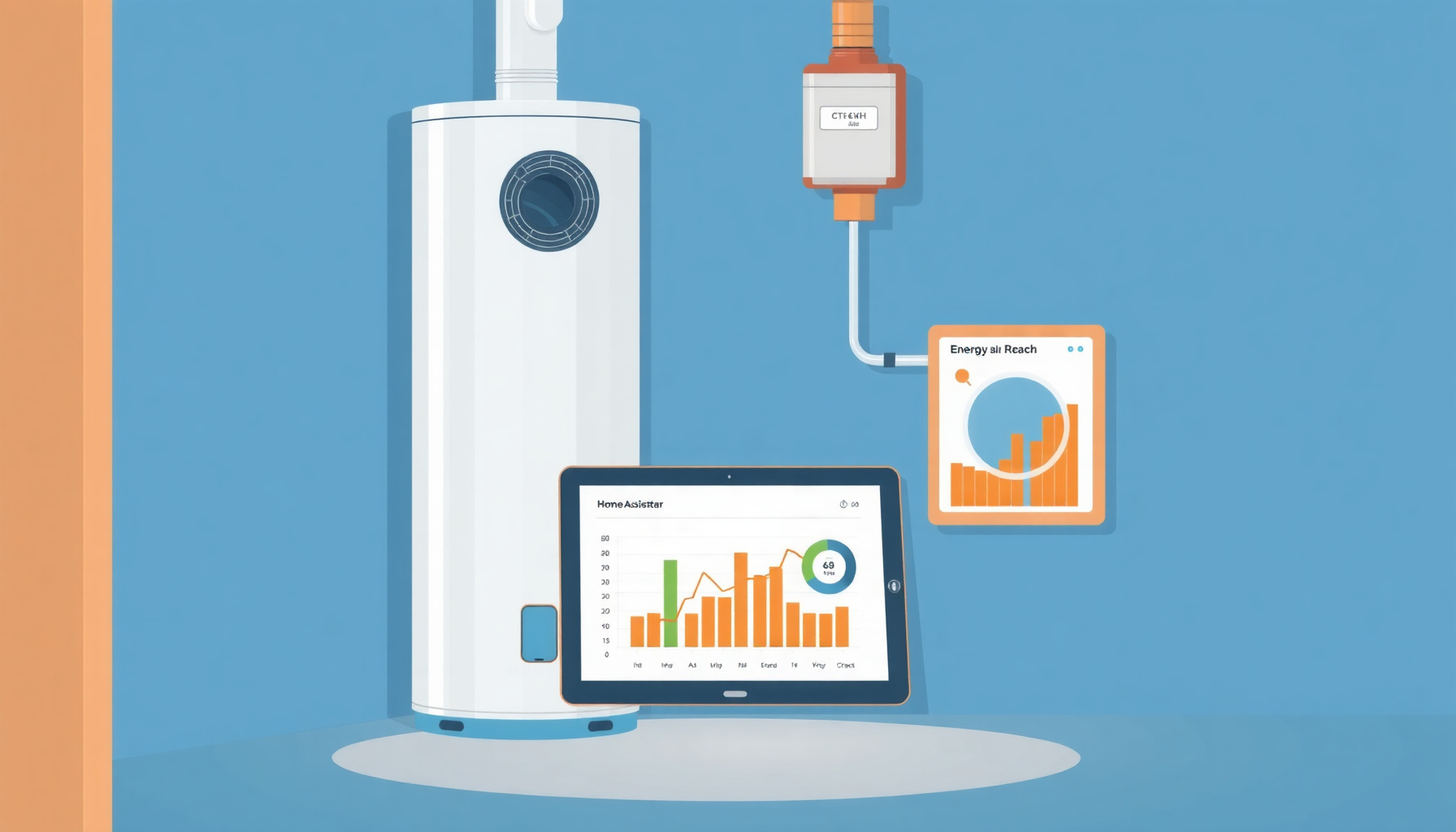
Measure Your Own Savings: Instrument the Circuit, Log It in Home Assistant
Before you buy: build a baseline
Put a CT clamp on the water heater circuit’s conductors and log kWh — not dollars — daily. Dollars move when rates move; kWh is the invariant that lets you compare before and after. Run the baseline across a representative stretch covering a full occupancy cycle and, ideally, more than one season, and log the daily series rather than the monthly total: a monthly average hides the vacation weeks and guest weekends that will make your after-install comparison lie.
After the swap
Same circuit, same meter, same comparison. Daily cost = kWh × your $/kWh. On a tiered or time-of-use tariff, apply the marginal rate to the marginal kWh rather than the blended average — otherwise a unit that shifts load off-peak will look better than it is, or worse. As a sanity check on your own rate, the EIA’s 2026 quarterly US averages are 17.83¢ / 18.51¢ / 18.34¢ / 18.16¢; if your effective rate sits far outside your division’s average, check whether you’re including fixed charges.
Connectivity and lock-in
The Home Assistant EcoNet integration consumes information from “a EcoNet enabled Rheem water heater or thermostat” and exposes binary sensor, climate, sensor, switch and water heater platforms. Two documented limits matter for a durable integration: “Water heaters do not report the current water temperature,” and the path is cloud-mediated through Rheem’s EcoNet service. It is not local control. Plan automations so a cloud outage degrades gracefully.
Availability is the bigger lock-in question. In the 719 models we analyzed, 526 are connected-capable and 193 are not: CTA-2045 + Wi-Fi 264, CTA-2045 only 180, Wi-Fi + CTA-2045 61, Wi-Fi + CTA-2045 + Bluetooth 18, none or unreported 196. CTA-2045 is checkable before purchase and is the more controller-friendly path. Separately, 294 models declare a time-of-use schedule field (425 blank) — on a TOU tariff, that field is worth more than a smart-speaker integration.
Who Should Not Buy One
Checkable disqualifiers:
- The room is under 450 cubic feet. Below that you’re outside even the permissive spec; between 450 and 700, verify against the model.
- The space regularly falls below about 37–40 °F. Median compressor cut-off across the 719 models is 37 °F. Below it, you have a resistance heater.
- Noise-sensitive adjacency. 45–60 dB per ENERGY STAR. Only 158 of 719 models report a dB figure — the other 561 don’t report one, which is not the same as quiet.
- You need more than ~91 gallons of first-hour hot water — the p90 of the models analyzed.
- You’re a two-person household. $342/yr and ~4.4-year payback is positive, but weaker.
- Your case depends on the $2,000 federal credit. In 2026 it isn’t there (IRS).
- You heat water with gas. Only “up to 70% less energy than traditional gas systems” is supported; conversion economics — panel capacity, venting removal, gas fixed charges — are out of scope here.
FAQ
Will it work in a cold garage or basement? Hybrid units keep making hot water below 40 °F because the resistance element takes over — you just lose efficiency. The median compressor cut-off in the 719 models analyzed is 37 °F, with a 10th percentile of 1 °F and a minimum of −26 °F, so a cold-weather-rated model exists if you need one. Split systems are rated to −25 °F.
How much will I actually save at 2026 prices? For a household of four: $685/yr at the 2026 US average of 18.21¢, ranging from $543 (West North Central) to $1,093 (New England), with payback of 1.4 to 2.8 years on the $1,503 incremental cost. Two people: $342/yr.
|Is the federal credit still available in 2026? |No. The IRS states the 25C credit “will not be allowed for any property placed in service after December 31, 2025” (IRS). ENERGY STAR copy still references it through that date. Budget without it. The credit was $2,000 maximum for heat pump water heaters.
How loud is it? 45–60 dB per ENERGY STAR — a refrigerator at the low end, a window AC at the high end. In the 719 models analyzed, only 158 report a sound figure: median 49 dB, range 37–54 dB. Unreported is not quiet.
How much space does it need? The sources disagree: about 700 cubic feet for most models with some at 450, versus “at least 450 cubic feet” as a general figure. Check the model’s own spec.
Will it cool my basement or raise my heating bill? It will cool the space somewhat — a 2022 Slipstream study of 81 basement installs found 2.3 °F reductions that returned to normal within 4 hours.1 A Canadian study found added heating loads were offset by HPWH savings.2
The Bottom Line
For an electrically heated home, a heat pump water heater is one of the few upgrades where the arithmetic survives contact with 2026 prices. A household of four saves $543 to $1,093 a year across the EIA’s 2026 regional rates, against a $1,503 incremental cost — a 1.4- to 2.8-year payback, with no federal credit assumed. The median certified unit in the 719 models we analyzed has a UEF of 3.70 and an FHR of 72 gallons, which fits most four-person homes.
But the number that matters isn’t in any table here. It’s on your panel. Verify three things before you buy — the room has the air space (450 cubic feet minimum, 700 to be safe), the space stays above roughly 37–40 °F in winter, and your peak demand sits under about 91 gallons. Then instrument the circuit, log kWh daily, and compute your own before-and-after. The brochure gives you a range. Your meter gives you an answer.
How This Guide Was Built
This is a documentation-based analysis, not a hands-on test. No heat pump water heater was installed, metered, or evaluated in a home for this article, and nothing here is a first-person measurement claim. Every figure traces to a published source: ENERGY STAR program pages and its certified-product dataset (719 models across 50 brands, retrieved 2026-11-03, the source of every UEF, FHR, volume, sound, cut-off, refrigerant and connectivity statistic), IRS guidance including the Public Law 119-21 FAQ, the EIA Short-Term Energy Outlook of October 2026, DOE Building America and NREL documents, and Home Assistant’s EcoNet documentation.
All arithmetic was recomputed and shown step by step so you can redo it at your own rate. Where the sources disagree, the disagreement is surfaced rather than averaged or explained away. Rated kWh/yr is a laboratory figure and is labeled as such.
📖 Related Reads
- ToolBrain — tool reviews, LLM comparisons, and AI workflow guides
Cross-links automatically generated from SmartHome Field Guide.
← Back to guides